Opuliss Journal
Brown Lip Liner on Deep Skin, and How to Line Two-Toned Lips
No brown liner is named as the match for deep skin, because none has been photographed on deep skin under one fixed light, and that call without a picture is a guess. For a two-toned lip the answer is a method, not a shade: fill the whole lip rather than outlining it, build in thin passes, blend the inner edge. What the range holds is four brown liners, each placed by the words on its own page: Coffee, a deep red-brown, Berry Brown, a warm brick brown, Sable Brown, a warm medium brown, and Cinnamon, a warm cinnamon brown. The method is the answer because the upper and the lower lip measure as two different colours, so a pencil drawn round the whole mouth is crossing two backgrounds and can read differently on each.

What this page can tell you, and what it cannot
This page is an explanation, not a recommendation. Opuliss has not yet photographed its lip liners on deep skin under one fixed light, and until that picture exists, naming a shade as the match for deep skin would be a guess wearing the clothes of advice. What the page can do is three things. It sets out what the range actually contains at the brown end, in the words each product page uses. It explains the pigment chemistry that decides whether a brown reads warm, cool, grey or deep once it is on a lip. And it says plainly where the range runs thin, because a gap is worth knowing before a purchase rather than after one. Everything below is drawn from published measurement, from the ingredient lists Opuliss publishes, and from ordinary application technique, which is named as such where it appears.

What does a two-toned lip look like when it is measured?
Lip colour has been measured directly rather than described. A cosmetics research team compared three instruments on natural lips: a high-resolution camera, a spectrophotometer and a hyperspectral imaging system. All three agreed on the same pattern. The lower lip measured lighter, redder, less yellow and more saturated than the upper lip on the same face (Vergnaud 2023). That was measured on a small group of white French women, so it is a starting point rather than a map of every mouth. A separate study, a pilot for a facial prosthesis shade guide rather than cosmetics research, measured the nose and the lower lip across several groups and reported that where on the face a reading was taken contributed significantly to the colour recorded, alongside group (Wee 2013). The lip is its own colour, and the two lips are not one colour.

How much does natural lip colour vary?
A great deal, and it varies most in exactly the dimensions a brown liner has to work with. Natural lower lip colour was measured with a full-face hyperspectral system across Caucasian French, Caucasian American, African American and Hispanic American women, and the authors reported lip colour as a continuous colour space with wide variation both within and between groups, widest among African American women in chroma and lightness (Vergnaud 2024). A later study from the same programme extended the work to women recruited in the United States, France and China and built a reference chart of 53 lip tones, ordered by lightness and hue. The groups overlapped enough that the authors concluded lip colour is not defined by group membership alone (Charton 2026).

What actually colours a brown lip liner?
Mostly minerals, and not only minerals. Colour scientists at a cosmetics laboratory set the mineral side out plainly: the inorganic pigments used in cosmetics are very limited, mainly red, yellow and black iron oxide with white titanium dioxide, and sometimes ultramarine blue and a chromium oxide green, preferred to organic pigments partly for better opacity (Ikkai 2023). The may-contain list on all four Opuliss brown liners carries that whole set, then goes past it with mica, an iron blue and three organic colour lakes, which are the class the paper sets the inorganics against. The iron oxides build every brown between them, red and yellow warming a shade, black deepening it. Titanium dioxide is the white, and how much of it a shade carries decides how opaque the line sits. The blues and the green take a brown away from red, which is ordinary pigment mixing rather than a finding from the paper.

What does the brown range hold?
Four liners, and each page states its own shade in one line. Lip Liner Coffee is described as a deep red-brown. Lip Liner Berry Brown is a warm brick brown. Lip Liner Sable Brown is a warm medium brown. Lip Liner Cinnamon is a warm cinnamon brown. All four share one formula and one set of specifications: a finish the page calls natural, buildable coverage, paraben-free, cruelty-free, made in North America. Three of the four pages use the word warm. Coffee's page names a colour and not an undertone, so reading it as warm is an inference from the word red rather than something the page says. Nothing in the four is described as cool, and nothing is described as neutral.

Where does the brown range run thin?
At the deep end and on the cool side, and that should be said plainly rather than softened. Nothing in the four browns is described as deeper than a deep red-brown, and nothing is described as cool or neutral. If your own lip reads deeper than Coffee, or cool rather than warm, this range does not hold a liner labelled for it. The direction of that miss is not unusual. When a set of commercial skin-tone pigments was measured against human lip and nose colour, the pigmented samples came out lighter and less red than the faces they were meant to match (Hungerford 2013). Those were prosthetics pigments rather than cosmetics, but the history of ranges that end this way is told in How Many Shades Is Enough?

Why does a wax pencil lay colour down the way it does?
All four liners share one build. A four-wax core of microcrystalline wax, paraffin, carnauba and beeswax holds a sharpened point, and castor seed oil with cushioning emollients carries the colour on. Both halves matter to how a shade reads. In a study comparing pigment-dispersing oils in lipstick, castor oil dispersions were the most viscous, the stickiest and the hardest to spread of the three oils tested, a red lake absorbed more castor oil than the alternatives, and the castor oil sticks came out among the hardest and most elastic. The same study found the colour of a stick and the colour it spread on paper were very similar (Maktabi 2021). Those were lipsticks rather than these pencils, and the useful point carries anyway.

How do you line a two-toned lip?
Think of the mouth as two backgrounds rather than one. Because the upper and the lower lip measure as different colours, one pass of liner drawn straight round can sit on a lighter, redder lower lip and a deeper, yellower upper one, and it will not read the same on both. An opaque line covers the lip it is drawn on. A sheer one lets that lip show through and mixes with it. Three ordinary ways round it, none of them a study finding. Fill the whole lip with the liner instead of only outlining, so the pencil becomes the background and anything above it starts from one colour. Build in thin passes, since all four are described as buildable, and stop when the two lips read together. Blend the inner edge with a brush or a fingertip rather than leaving a hard boundary, because that boundary is what shows first in daylight.

What goes over the liner, and what is in it?
Two finishes that do opposite jobs. Lip Gloss Clear is the colourless shade in that range: its one-line shade description calls it a colourless, glassy shine on a cushiony, non-castor oil base. Take the no-colour reading from that line rather than from the rest of the page, because the description also calls it a sheer to buildable wash of colour and the may-contain list it shares with the coloured shades carries titanium dioxide, iron oxides, mica and several lakes. Its ingredient list includes fragrance, which is worth knowing if you avoid it. Matte Lip Stain Deep Burgundy works the other way. A quick-setting silicone-resin film, trimethylsiloxysilicate, holds the pigment for a velvet matte that builds to full colour, and the page marks that as a description of the formula's film and wear rather than a measurement. It is built on candelilla wax rather than beeswax.

What would turn this page into a recommendation?
One thing. A photograph of each liner worn on deep skin, under one fixed light, beside the others. Until that exists, every shade sentence here is a quotation from a product page and not a claim about how a colour will look on you. That standard is not fussiness. The instruments and the reference data colour work is built on were assembled on a narrower range of skin than the people buying it, which is the subject of The Formulation Gap and Why Universal Shades Are Not. One more fact from the lists, since it is easy to assume otherwise: the four liners carry beeswax and lanolin, so they are not vegan.
References
- Vergnaud H, Cherel M, Francois G, Charton Z, Loescher E, Caisey L, Gazano G. Lip color measurement: A new hyperspectral imaging device. Skin Res Technol. 2023, 29(8):e13418. PMID 37632193. doi.org/10.1111/srt.13418
- Wee AG, Beatty MW, Gozalo-Diaz DJ, Kim-Pusateri S, Marx DB. Proposed shade guide for human facial skin and lip: a pilot study. J Prosthet Dent. 2013, 110(2):82-89. PMID 23929369. doi.org/10.1016/S0022-3913(13)60344-3
- Vergnaud H, Charton Z, Blumenthal D, Couturaud V, Le Fur M, Loescher E, Caisey L, Gazano G. Lip color diversity: An intricate study. Skin Res Technol. 2024, 30(2):e13583. PMID 38284291. doi.org/10.1111/srt.13583
- Charton Z, Vergnaud H, Caisey L, Blumenthal D, Ma M, Shi A, Couturaud V, Xu T, Loescher E. Development of a lip colour chart across four ethnicities. Int J Cosmet Sci. 2026, 48(1):161-171. PMID 40931437. doi.org/10.1111/ics.70004
- Ikkai F, Blaksley C, Hayashi R, Jaspers A. Cosmetic effects of red-light reflection by ultramarine blue pigment. Int J Cosmet Sci. 2023, 45(3):413-423. PMID 36864649. doi.org/10.1111/ics.12849
- Hungerford E, Beatty MW, Marx DB, Simetich B, Wee AG. Coverage error of commercial skin pigments as compared to human facial skin tones. J Dent. 2013, 41(11):986-991. PMID 23907084. doi.org/10.1016/j.jdent.2013.07.010
- Maktabi B, Liberatore MW, Baki G. Meadowfoam seed oil as a natural dispersing agent for colorants in lipstick. Int J Cosmet Sci. 2021, 43(4):484-493. PMID 34240435. doi.org/10.1111/ics.12724
Shop the edit
What are the best Opuliss products?
Every Opuliss formula is made to earn its place in your ritual. These are the pieces our community reaches for first.
 Coral Lip Gloss
A high-shine lip gloss on a cushiony, non-castor oil base that gives glass-like shine and a smooth, non-s...
 Warm Nude Foundation
A silicone-in-water foundation that evens tone and leaves a luminous, dewy finish, buildable from a sheer...
 Juliet Automatic Lip Liner
A retractable, no-sharpen lip liner that glides on rich, precise color and holds a defined lip line throu...
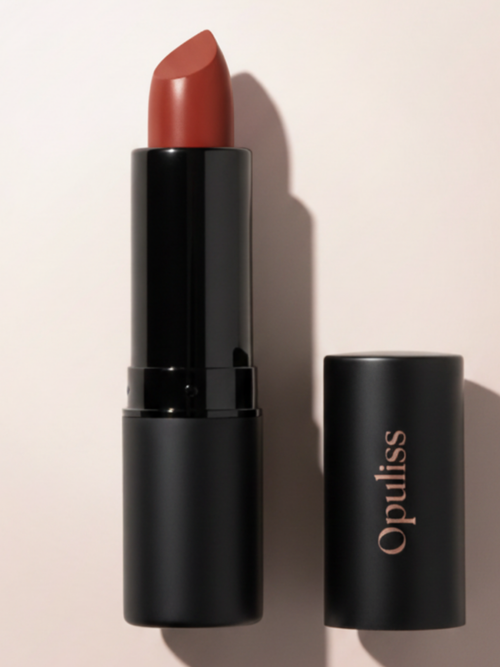 Misty Mauve Beeswax Lipstick
A cast lipstick that lays down rich, saturated color in one smooth, comfortable stroke and sets to a soft...
The Opuliss list
Join the Opuliss list
New rituals, ingredient stories, and first access to launches.

Opuliss Beauty
MAKEUP WORTH STANDING BEHIND
Cruelty-free, made to order, and every ingredient named. Explore the collection.
Discover the collection