All Ingredients/Vitamin E

Vitamin E
Summary
Vitamin E is an antioxidant, listed on ingredient labels as Tocopherol. In a formula it works as an antioxidant or skin conditioning agent, and skin receives a supply of its own, carried to the surface in sebum.
Defence in the formula
Vitamin E is a family of related compounds, and Tocopherol is the name it takes on an ingredient list. An expert panel that assessed the safety of the tocopherols and tocotrienols used in cosmetics reported that the tocopherols work in cosmetics as antioxidants or skin conditioning agents, and concluded that they are safe as used.1
Across the Opuliss Skin range, Tocopherol appears in the full ingredient lists of 45 products, read on 30 September 2026. It is never among the first five ingredients in any of them, and its median place is twentieth, well down the list. We file it under Antioxidant Defence.
Defence in the lipid
Skin has its own route for vitamin E. A study measuring it in the outer layer of the skin found about 20 times as much alpha-tocopherol in the upper layers of the cheek as in the same layers of the upper arm. It traced the difference to sebum, which carried both alpha and gamma tocopherol continuously to the surface of the face, in step with squalene, a marker of sebum. The authors suggested this may help protect the skin's surface lipids and upper layers from harmful oxidation.2
Defence in the evidence
The two sources behind this entry answer different questions, and they should be read that way. The sebum study is a measurement of how vitamin E reaches facial skin naturally.2 The expert panel review is a safety assessment that also records what the ingredient does in a formula.1 Neither is a trial of an applied vitamin E product on skin.
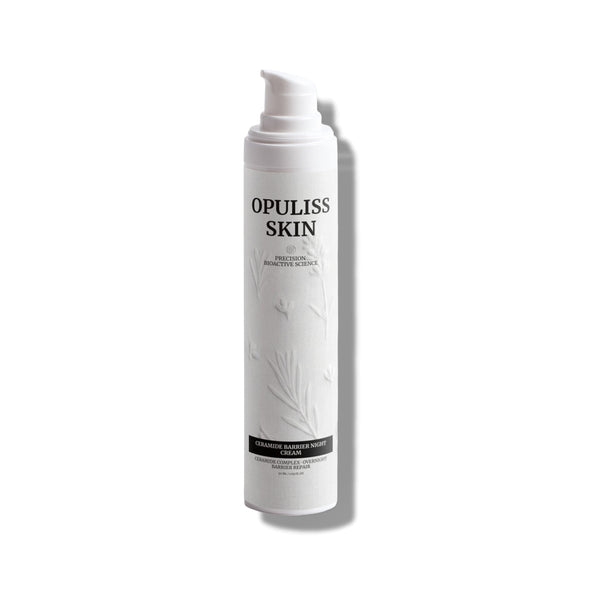
THE RADIANCE BODY OIL lists Tocopherol as the antioxidant in its blend of seven plant oils, and the CERAMIDE BARRIER NIGHT CREAM carries it alongside a natural ceramide complex and Ascorbyl Palmitate. Our longer article on vitamin E, the antioxidant that is not a sunscreen covers what it can and cannot do.
Defence and its limits
The skin's own vitamin E supply is not evidence that adding more changes the skin, and the safety review records a function rather than measuring a result. Vitamin E is not a sunscreen, and nothing here should be read as one. These sources describe the ingredient, not any finished Opuliss product.
Cosmetic claims describe how skin looks and feels. Nothing here is a promise about a bottle.
Sources
- Fiume MM, Bergfeld WF, Belsito DV, et al. Safety Assessment of Tocopherols and Tocotrienols as Used in Cosmetics. Int J Toxicol. 2018, 37(2_suppl):61S-94S. DOI 10.1177/1091581818794455. PubMed PMID 30235959 (Fiume 2018).
- Thiele JJ, Weber SU, Packer L. Sebaceous gland secretion is a major physiologic route of vitamin E delivery to skin. J Invest Dermatol. 1999, 113(6):1006-10. PubMed PMID 10594744 (Thiele 1999).