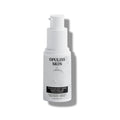
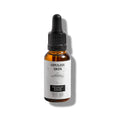
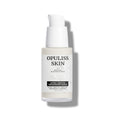
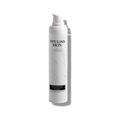
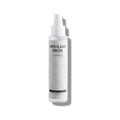
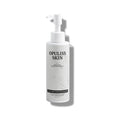
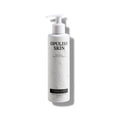
CELLULAR ANTI-AGING RESURFACING CONCENTRATE
A leave-on resurfacing concentrate built on 10% Lactic Acid, an alpha-hydroxy acid that loosens surface corneocyte cohesion at pH 4.0 to 4.2 to help refine the look of texture. This fluid serum smooths the appearance of uneven tone, supported by hydrating Sodium Hyaluronate and antioxidant White Tea and Sage, for photoaged and blemish-prone skin seeking visible renewal.
Backed by published research · references belowHow subscriptions work
- Your ritual, uninterrupted. Each refill arrives before the last one runs out, at 20% off with complimentary shipping, every time.
- We email you ten days before each refill ships, and you are only billed on the day it ships.
- Pause, skip a delivery, or cancel whenever you wish. No minimum commitment.
Subscription pricing carries its own saving and does not combine with other offers or codes.
Formulated for anti-aging, hyperpigmentation, darker skin tones, and acne-prone concerns.
- Lactic Acid, an alpha-hydroxy acid (AHA) used here at 10%, improved skin smoothness, epidermal firmness and the appearance of lines and wrinkles in people applying 5% or 12% topically1. Topical alpha-hydroxy acids are documented to improve the look of photoaged skin over months of consistent use2.
- Sodium Hyaluronate, a surface humectant, hydrates and helps offset the transient water loss that can accompany AHA exfoliation.
- White Tea and Sage leaf extracts, antioxidant polyphenol botanicals, add environmental support.
Hero mechanism: Lactic Acid, an alpha-hydroxy acid, loosens corneocyte cohesion at the stratum corneum to support surface renewal. Full mechanism and citations under Details and references.
The Opuliss Skin Cellular Anti-Aging Resurfacing Concentrate is a 30 ml / 1.01 fl oz leave-on alpha-hydroxy acid serum built on 10% Lactic Acid at pH 4.0 to 4.2, paired with Sodium Hyaluronate and organic White Tea and Sage leaf extracts. The formula is COSMOS Natural eligible and vegan eligible.
Aqua/Water, Lactic Acid, Pentylene Glycol, Potassium Hydroxide, Butylene Glycol, Glycerin, Sodium Hyaluronate, Camellia Sinensis (White Tea) Leaf Extract, Salvia Officinalis (Sage) Leaf Extract.
Active ingredients: 10% Lactic Acid (alpha-hydroxy acid exfoliant, keratolytic at pH 4.0 to 4.2), Sodium Hyaluronate (surface humectant), Camellia Sinensis (White Tea) Leaf Extract (polyphenol antioxidant), Salvia Officinalis (Sage) Leaf Extract (rosmarinic acid antioxidant).
Aqua/Water, Lactic Acid, Pentylene Glycol, Potassium Hydroxide, Butylene Glycol, Glycerin, Sodium Hyaluronate, Camellia Sinensis (White Tea) Leaf Extract, Salvia Officinalis (Sage) Leaf Extract
The ingredient list printed on your product’s packaging is always definitive; where it differs from this page, the packaging prevails.
Apply two to three drops to clean skin in the evening, two to three times per week. Begin with one application per week and titrate up as tolerated. Avoid contact with eyes and lips. Always layer with broad-spectrum SPF 30 or higher daily. AHA leave-on products increase the skin's sensitivity to UV exposure.
COSMOS Natural eligible, vegan eligible. AHA sun protection advisory: this product contains 10% Lactic Acid as a leave-on alpha-hydroxy acid. The FDA cosmetic AHA labeling guidance recommends daily use of broad-spectrum SPF 30 or higher and avoidance of unprotected sun exposure during use and for one week after discontinuation. Patch test on the inner forearm for 24 hours before facial use. Do not use on broken, irritated, or sunburned skin. Avoid concurrent application with strong retinoid or BHA products in the same routine until tolerance is established. Pregnancy and nursing: consult your dermatologist before use.
- Smith WP. Epidermal and dermal effects of topical lactic acid. Journal of the American Academy of Dermatology. 1996;35(3):388-91. DOI 10.1016/s0190-9622(96)90602-7. PubMed PMID 8784274.
- Ditre CM, Griffin TD, Murphy GF, et al. Effects of alpha-hydroxy acids on photoaged skin: a pilot clinical, histologic, and ultrastructural study. Journal of the American Academy of Dermatology. 1996;34(2 Pt 1):187-95. DOI 10.1016/s0190-9622(96)80110-1. PubMed PMID 8642081.
How to cite this product page: Opuliss. Cellular Anti-Aging Resurfacing Concentrate. Opuliss Skin product page. 2026. https://opuliss.com/products/aha-peeling-concentrate
The Science


Lactic Acid is an alpha-hydroxy acid studied in cosmetics for gently exfoliating the skin's surface, supporting a smoother, brighter, more even-looking texture.
Source: Smith WP. Journal of the American Academy of Dermatology, 1996 (PMID 8784274).
INSIDE THE SCIENCE
From precision-fermented actives to biomimetic complexes, discover what makes it Opuliss.

LACTIC ACID
A gentle AHA that exfoliates to smooth texture and refine the look of tone.
Source: Smith WP. Journal of the American Academy of Dermatology, 1996 (PMID 8784274).

MULTI-WEIGHT HYALURONIC ACID
Holds water across several depths of the skin surface for visible plumping and lasting hydration.
Source: Pavicic T, et al. Journal of Drugs in Dermatology, 2011 (PMID 22052267).

WHITE TEA
Polyphenol antioxidant that helps defend against environmental stress.
Source: Elmets CA, et al. Journal of the American Academy of Dermatology, 2001 (PMID 11209110).
HOW TO USE

Apply two to three drops to clean skin in the evening, two to three times per week.
Begin with one application per week and titrate up as tolerated.

Avoid contact with eyes and lips. Always layer with broad-spectrum SPF 30 or higher daily. AHA leave-on products increase the skin's sensitivity to UV exposure.
THE TEXTURE

The Opuliss difference
SCIENCE, MADE VISIBLE
Opuliss begins where the research ends. Every active is named, every claim is traceable, and nothing is left to promise alone.
Morning to night
A RITUAL, CONSIDERED
Each formula stands on its own and belongs to the whole. Layered with intention, morning and night, the routine becomes unmistakably yours.
A twenty four hour rhythm
THE SKIN KEEPS TIME
Skin is not the same at midnight as it is at nine in the morning. Across a single day its temperature, its acidity and the moisture it loses to the air each move on a rhythm of their own. Morning and night are not two routines. They are one, kept in time.
Yosipovitch G et al. Journal of Investigative Dermatology, 1998 (PMID 9424081). Sixteen volunteers sampled every two hours across a twenty four hour span.