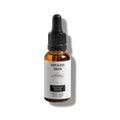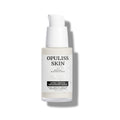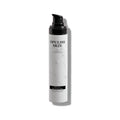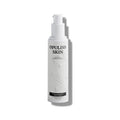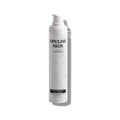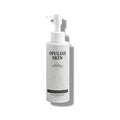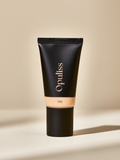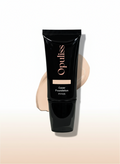
ZINC PCA BALANCING GEL
An oil-free hydrating gel powered by Zinc PCA, a component of skin's natural moisturising factor. Its weightless, oil-free texture helps with the look of oily, breakout-prone skin, while a multi-weight hyaluronic acid tier and a microbiome prebiotic complex hydrate and comfort, sitting cleanly under sunscreen and makeup without a greasy finish.
Backed by published research · references belowContains fragrance (Parfum). Full ingredients
Arrives in 4 to 7 business days in the US, 6 to 9 in the UK and up to 8 in France. UK orders may owe customs fees on delivery. This item ships free, as does every order of $100 or more. Read the returns policy
Formulated for Acne Prone and Oily Skin.
- Zinc PCA, the zinc salt of pyrrolidone carboxylic acid (PCA) and a component of skin's natural moisturising factor, helps with the look of oily and breakout-prone skin1.
- Sodium Hyaluronate, a humectant salt of hyaluronic acid, holds hydration for a comfortable, non-greasy finish2.
- Watercress Flower/Leaf Extract, a skin-conditioning botanical.
Hero mechanism: Zinc PCA, a component of skin's natural moisturising factor, is supported by published research on the zinc-ion class. Full mechanism and citations under Details and references.
A 50 ml / 1.69 fl oz oil-free hydrating gel built on Zinc PCA, a multi-weight Hyaluronic Acid tier, a microbiome prebiotic complex, and Watercress Flower/Leaf Extract, with no oil phase. 100% natural origin, 27% organic origin, vegan eligible.
Zinc PCA, Microbiome Prebiotic Complex (Rhamnose + Glucose + Glucuronic Acid), Watercress Flower/Leaf Extract, Sodium Hyaluronate.
Active ingredients:
- Zinc PCA, the zinc salt of PCA and a component of skin's natural moisturising factor
- Sodium Hyaluronate, a humectant
- Watercress Flower/Leaf Extract, a skin-conditioning botanical
Aloe Barbadensis (Aloe) Leaf Juice, Glycerin, Pentylene Glycol, Butylene Glycol, Betaine, Sclerotium Gum, Zinc PCA, Aqua, Propanediol, Parfum, Nasturtium Officinale (Watercress) Flower/Leaf Extract, Sodium Phytate, Potassium Hydroxide, Sodium Hyaluronate, Rhamnose, Glucose, Glucuronic Acid, Limonene, Linalool, Geraniol, Citral
The ingredient list printed on your product’s packaging is always definitive; where it differs from this page, the packaging prevails.
- Apply a small amount to clean skin morning and evening, after cleansing and any serum step.
- Massage gently into face and neck. Suitable for daily use on acne-prone and oily skin.
- The lightweight gel sits comfortably under sunscreen and makeup without a greasy finish.
Are there any side effects?
It contains naturally derived fragrance compounds (Limonene, Linalool, Geraniol, Citral). Patch test on the inner forearm before first use.
Does it actually work?
Zinc PCA pairs the mineral zinc with a natural moisturising factor, and cosmetic dermatology reviews describe zinc salts among the sebum-controlling agents used in skincare, helping this oil-free gel keep a fresher, less shiny-looking finish.
How do I use it?
Apply a small amount to clean skin morning and evening, after cleansing and any serum step. Massage gently into face and neck.
What is the difference between zinc and zinc PCA?
Zinc is a mineral. Zinc PCA is zinc bound to PCA, a moisture-binding part of the skin's own natural moisturising factor (Lin 2017), so one ingredient brings the mineral and a humectant together. Cosmetics have long used zinc PCA as an astringent (Takino 2012). In this oil-free gel it works alongside Glycerin, Betaine and Sodium Hyaluronate.
100% natural origin, 27% organic origin, vegan eligible. Contains naturally derived fragrance compounds (Limonene, Linalool, Geraniol, Citral). Patch test on the inner forearm before first use. Avoid contact with the eyes.
Zinc PCA is the zinc salt of pyrrolidone carboxylic acid (PCA), one of the documented constituents of skin's natural moisturising factor, supported by published research on the zinc-ion class in human skin1. Sodium Hyaluronate is a glycosaminoglycan naturally present in skin that helps it retain moisture2.
- Sugimoto Y, Lopez-Solache I, Labrie F, Luu-The V. Journal of Investigative Dermatology. 1995;104(5):775-8. DOI 10.1111/1523-1747.ep12606985. PubMed PMID 7738354.
- Papakonstantinou E, Roth M, Karakiulakis G. Dermato-Endocrinology. 2012;4(3):253-258. DOI 10.4161/derm.21923. PubMed PMID 23467280.
- Lin TK, Zhong L, Santiago JL. Anti-Inflammatory and Skin Barrier Repair Effects of Topical Application of Some Plant Oils. International Journal of Molecular Sciences. 2018, 19(1):70. DOI 10.3390/ijms19010070. PubMed PMID 29280987.
- Takino Y, Okura F, Kitazawa M, et al. Zinc l-pyrrolidone carboxylate inhibits the UVA-induced production of matrix metalloproteinase-1 by in vitro cultured skin fibroblasts, whereas it enhances their collagen synthesis. International Journal of Cosmetic Science. 2012, 34(1):23-8. DOI 10.1111/j.1468-2494.2011.00676.x. PubMed PMID 21834944.
How to cite this product page: Opuliss. Zinc PCA Balancing Gel. Opuliss Skin product page. 2026. https://opuliss.com/products/oil-free-hydrating-gel
The Science


Zinc PCA pairs the mineral zinc with a natural moisturising factor, and cosmetic dermatology reviews describe zinc salts among the sebum-controlling agents used in skincare, helping this oil-free gel keep a fresher, less shiny-looking finish.
Source: Dall'Oglio F, et al. Giornale Italiano di Dermatologia e Venereologia, 2014 (PMID 25315288).
INSIDE THE SCIENCE
From precision-fermented actives to biomimetic complexes, discover what makes it Opuliss.

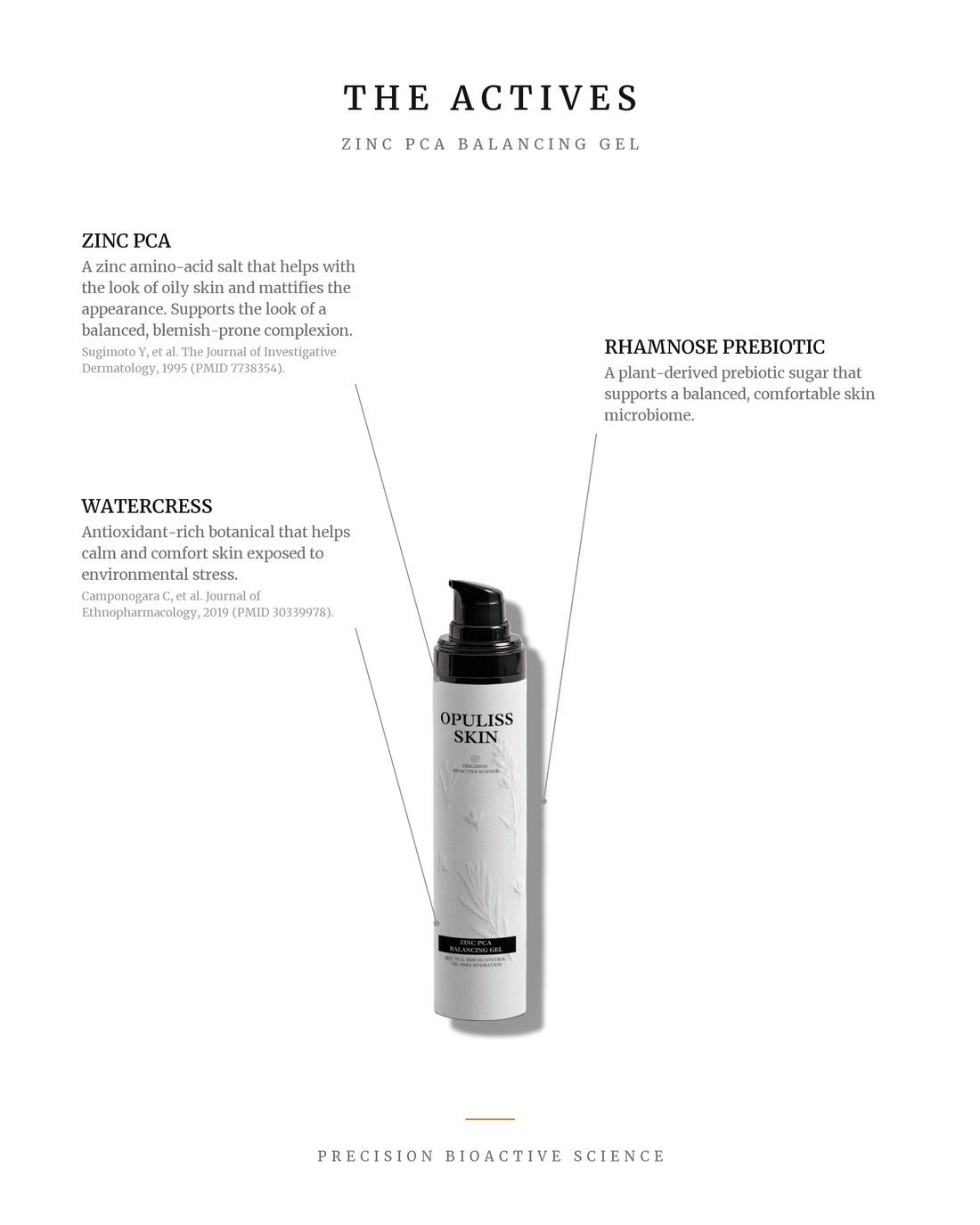
ZINC PCA
The zinc salt of PCA, long used in cosmetics as an astringent. In lab tests on human skin cells it curbed a collagen-breaking enzyme that UVA light switches on, and raised collagen production.
Source: Takino Y, et al. International Journal of Cosmetic Science, 2012 (PMID 21834944).

RHAMNOSE
A plant sugar. In lab-grown skin and in a clinical study, rhamnose had a positive effect on collagen IV and procollagen I production, in the skin layers that ageing affects.
Source: Pageon H, et al. International Journal of Cosmetic Science, 2019 (PMID 30845349).

WATERCRESS
A botanical containing rutin and ferulic acid. In a laboratory study, watercress extract applied to irritated mouse skin reduced swelling.
Source: Camponogara C, et al. Journal of Ethnopharmacology, 2019 (PMID 30339978).
HOW TO USE

Apply a small amount to clean skin morning and evening, after cleansing and any serum step.

Massage gently into face and neck. Suitable for daily use on acne-prone and oily skin.
The lightweight gel sits comfortably under sunscreen and makeup without a greasy finish.
THE TEXTURE

The Opuliss difference
SCIENCE, MADE VISIBLE
Opuliss begins where the research ends. Every active is named, every claim is traceable, and nothing is left to promise alone.
Morning to night
A RITUAL, CONSIDERED
Each formula stands on its own and belongs to the whole. Layered with intention, morning and night, the routine becomes unmistakably yours.
A twenty four hour rhythm
THE SKIN KEEPS TIME
Skin is not the same at midnight as it is at nine in the morning. Across a single day its temperature, its acidity and the moisture it loses to the air each move on a rhythm of their own. Morning and night are not two routines. They are one, kept in time.
Yosipovitch G et al. Journal of Investigative Dermatology, 1998 (PMID 9424081). Sixteen volunteers sampled every two hours across a twenty four hour span.